


There are routes that you enjoy… and others that you remember for a lifetime. A motorcycle trip to the Alps, with the freezing air hitting your helmet as you crest a mountain pass at over 2,000 meters high, is one of those unforgettable experiences. Perfect curves, legendary mountain passes, and landscapes that seem designed for riding.
At Moto Map Travel, we know that facing this route requires more than just desire; it demands technical preparation and a bike up to the challenge. If you are planning your first foray into Europe’s most famous peaks, these tips will put you on the right line.
Where are the Alps located and which countries do they cover?
The Alps form the most important mountain range in Europe, stretching over 1,200 kilometers and crossing eight countries: France, Italy, Switzerland, Austria, Germany, Slovenia, Liechtenstein, and Monaco. For you as a motorcyclist, this means something unique: crossing borders without ever stopping your ride through the mountains.
In just a few kilometers, you can go from historic Italian roads to impeccable Swiss passes or the technical tracks of the Austrian Tyrol. This diversity makes the Alps an ideal destination for motorcycle trips, where each day offers a different culture, distinct gastronomy, and completely new roads.
Why are the Alps so famous?
The fame of the Alps among the motorcycling community lies in their verticality and the engineering of their roads. Alpine passes, or cols, are designed with a succession of hairpin turns that seem to never end.
Many of these passes were originally built as strategic military or commercial routes, which explains their layouts full of linked curves. Today, they are authentic temples of touring and adventure motorcycling.
Furthermore, the infrastructure is completely geared towards motorcycle tourism; it is common to find hotels with specialized garages and meeting points where a spirit of motorcycle brotherhood can be felt.
It is the only place where you can have breakfast on a Swiss terrace looking at a glacier and lunch on a plate of pasta in an Italian valley after having conquered 48 consecutive curves.
What to visit on a motorcycle trip to the Alps? Which is the best area for a route?
Each border offers a different type of asphalt and motorcycling culture. While in France the roads are wide and fluid, in Italy you will encounter tighter and more technical hairpin turns that will test your balance and your machine’s torque.
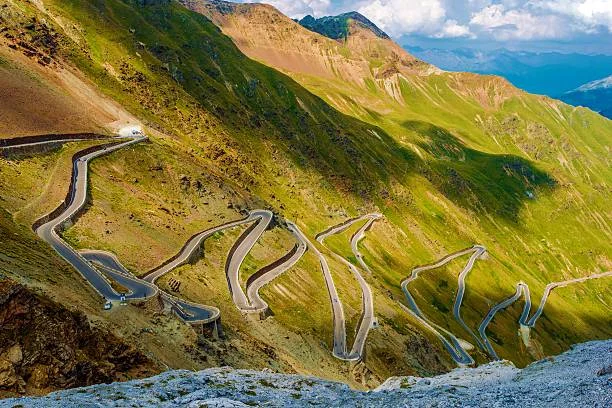
Paso Stelvio (Italia)
Probably the most famous mountain pass in the world. Its tight curves and altitude exceeding 2,700 meters make it a mandatory experience for any motorcycle traveler. It is a technical challenge that requires expert hands and an agile motorcycle.
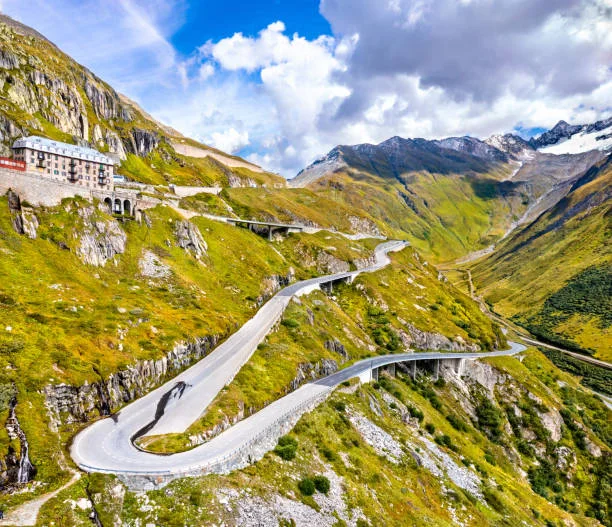
Furka Pass and Grimsel Pass (Switzerland)
Located in the heart of Switzerland, these passes offer movie-like landscapes—literally, as scenes from James Bond were filmed here.
Their curves are wide, fast, and surrounded by walls of ice and turquoise blue lakes. As if that weren’t enough, the area boasts perfectly maintained panoramic roads.
The riding flows here, and the glacial landscape creates a unique sense of vastness.
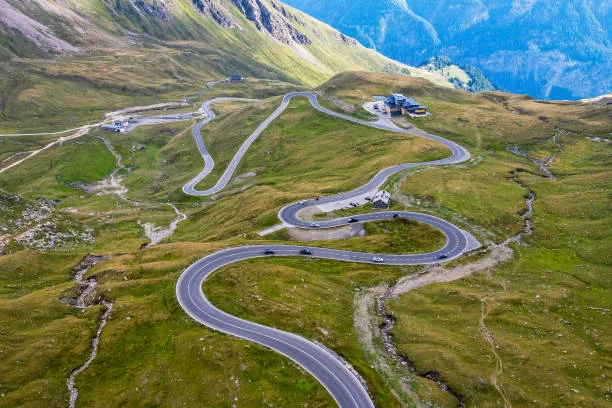
Grossglockner High Alpine Road (Austria)
A road designed for driving enjoyment. Wide, safe, and with constant viewpoints where the vistas of Austria’s highest peak are simply breathtaking.
It is a toll road, but every euro invested translates into pure riding pleasure. Ideal for those seeking a balance between technical riding and scenery.
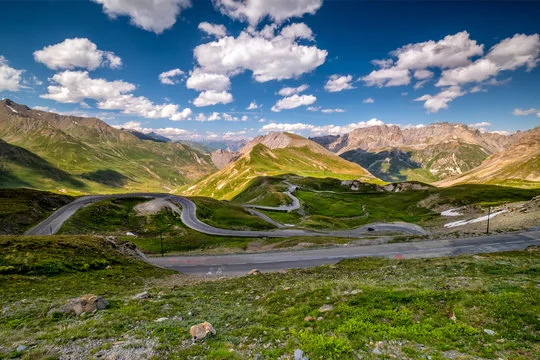
La Route des Grandes Alpes (Francia)
This route crosses the French Alps from north to south, stretching from Lake Geneva to the Mediterranean Sea.
It is the essence of long-distance travel, traversing legendary mountain passes like the Galibier or the Iseran—the highest paved pass in the Alps.
How much time is required to travel across the entire Alps?
Attempting to travel the Alps from end to end in a single week is a common mistake that usually ends in exhaustion.
To cross the mountain range from Nice to Slovenia while enjoying the best passes, the ideal approach is to reserve at least 14 days. If you have less time, 7 to 9 days are perfect for focusing on a specific area, such as the Austrian Tyrol or the Italian Dolomites.
Remember that in the mountains, distances are measured in hours, not kilometers, as average speeds are typically low due to the winding terrain. The key is prioritizing quality over quantity and leaving room for rest and weather changes.
What is the best season for a motorcycle trip to the Alps?
The best time is from mid-June to mid-September. Before June, many of the highest passes (such as the Stelvio or the Gavia) remain closed due to snow. In July and August, the weather is perfect, although you will find more traffic from motorhomes and cyclists.
September offers spectacular light and fewer crowds, but temperatures begin to drop rapidly when the sun goes down. You should always be prepared for a mountain storm at any time of year.
Traveling with guides who know alternative routes allows you to avoid crowds and discover lesser-known roads.”
What budget is needed for a motorcycle trip to the Alps?
The budget for traveling to the Alps by motorcycle depends on the travel style and the countries you cross, but it is advisable to calculate realistically.
Alpine accommodations usually range between €120 and €220 per night in comfortable hotels oriented toward motorcyclists. Eating in local restaurants can cost between €25 and €45 per person, especially in Switzerland or Austria.
A detail to consider is that many Austrian passes are toll roads (around €30-€40), so you should include them in your final budget to avoid surprises.
Many travelers choose to rent a motorcycle in Europe, avoiding logistical costs and mechanical wear and tear. At Moto Map Travel you can rent touring or adventure models that are perfectly prepared, in addition to joining guided routes where accommodation, itinerary, and assistance are already organized.
Final tips for an unforgettable trip:
- Plan realistic stages and avoid accumulating too many passes in a single day.
- Always check the weather before heading out, as it can change in a matter of hours.
- Bring waterproof gear even if the forecast is favorable.”
- Leave room for improvisation. Often the best memories appear at an unexpected viewpoint or in a small Alpine village where you decide to stop without having planned it.
- The gaze is key. In tight uphill curves, always look toward the exit of the curve, not at the front wheel; this will prevent the bike from “falling” toward the inside.
- Documentation up to date. Make sure to carry your insurance Green Card and check if you need vignettes (toll stickers) for the highways in Switzerland or Austria.
- Do not travel alone if it is your first time. Logistics and weather changes can be overwhelming; having an expert guide makes the difference between stress and enjoyment.
Live the legend of the Alps with Moto Map Travel.
A motorcycle trip to the Alps doesn’t have to be complicated. At Moto Map Travel, we understand that your priority is to enjoy the scenery and the lean in every curve. That’s why we offer our high-end motorcycle rental service, with bikes fully equipped and inspected to withstand the demands of the high mountains.
If you prefer to forget about maps and reservations, you can join our guided tours, where we take care of selecting the best hotels and the most spectacular passes. Let us handle the logistics while you focus on conquering the summit.
Contact us and make your trip a reality!